Did New Brunswick get old before it got rich?

One of the concepts that is used when it comes to international economic development is the concern that a country will get old before it gets rich. Rich here would be defined as having close to an advanced economy GDP per capita and the idea is that if a country has grown relatively ‘rich’ it is better positioned to support is older population with pensions, health care, etc. If a country grows old before rich the idea is that it will be a tough country for folks in their golden age. China, for example, is a country that seems to be getting old before rich - although on what is called a purchasing power basis that country’s GDP per capita is approaching first world ($13k the normal calculation, $41K using PPP).
I was speaking to Dr. Dhirendra Shukla’s class this week and and proposed (kind of blurted out) that New Brunswick might have become old before it became rich. In this case, the term ‘rich’ would need to be defined as the ability to sustainably pay for public services even as the population ages. We cannot. We require nearly $4,000 per capita in ‘equalization’ from the federal government for the provincial government to provide public services each year. And on the public pension front New Brunswick receives 50% more Old Age Security (OAS) and net federal supplement dollars for seniors - as a share of total income.
The chart shows the trend in GDP per capita and median age and, indeed, it looks like after a sustained period of per capita growth from the early 1980s to early 2000s has been replaced by a stagnant GDP per capita since. You will see the median age grew almost in parallel from 27 years in 1981 to 46 years in 2020 - we have gotten ‘younger’ as a population since as a result of inward migration.
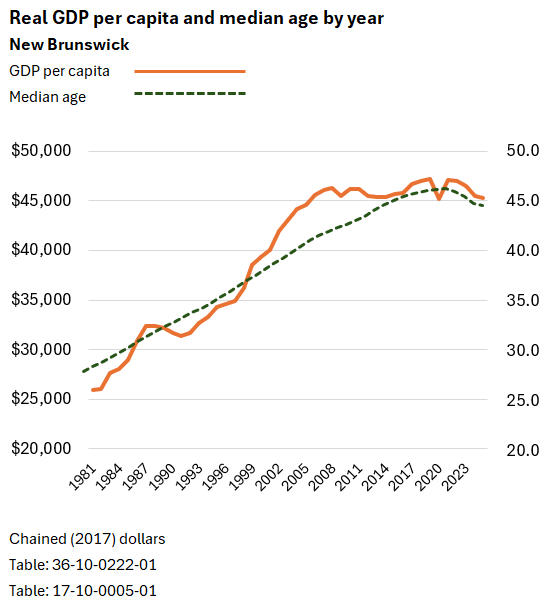
So what can we conclude? If Premier Shawn Graham had his way and we had become ‘self-sufficient’ (i.e. no Equalization) by 2026, New Brunswick would have indeed gotten ‘rich’ before ‘old’ (putting aside the pension thing). He didn’t get his way and we now require a large cheque from other Canadians each year to pay the bills.
Of course, the difference with Canada is that we can change our demographic destiny - at least slowly and deliberately - through international migration. There are lots of folks that would like to live in a place like Canada. So, if we can drive economic growth in new industries (e.g. mining, IT, aquaculture, farming, etc.) and bring in immigrants to help meet workforce demand, we can avoid the worst consequences of getting old before rich and ensure that all New Brunswickers can access good quality public services throughout their lives.